Cold open
The diagram was wrong, the spreadsheet was current, and the truth was distributed across six people who had never been in the same meeting.
The scene
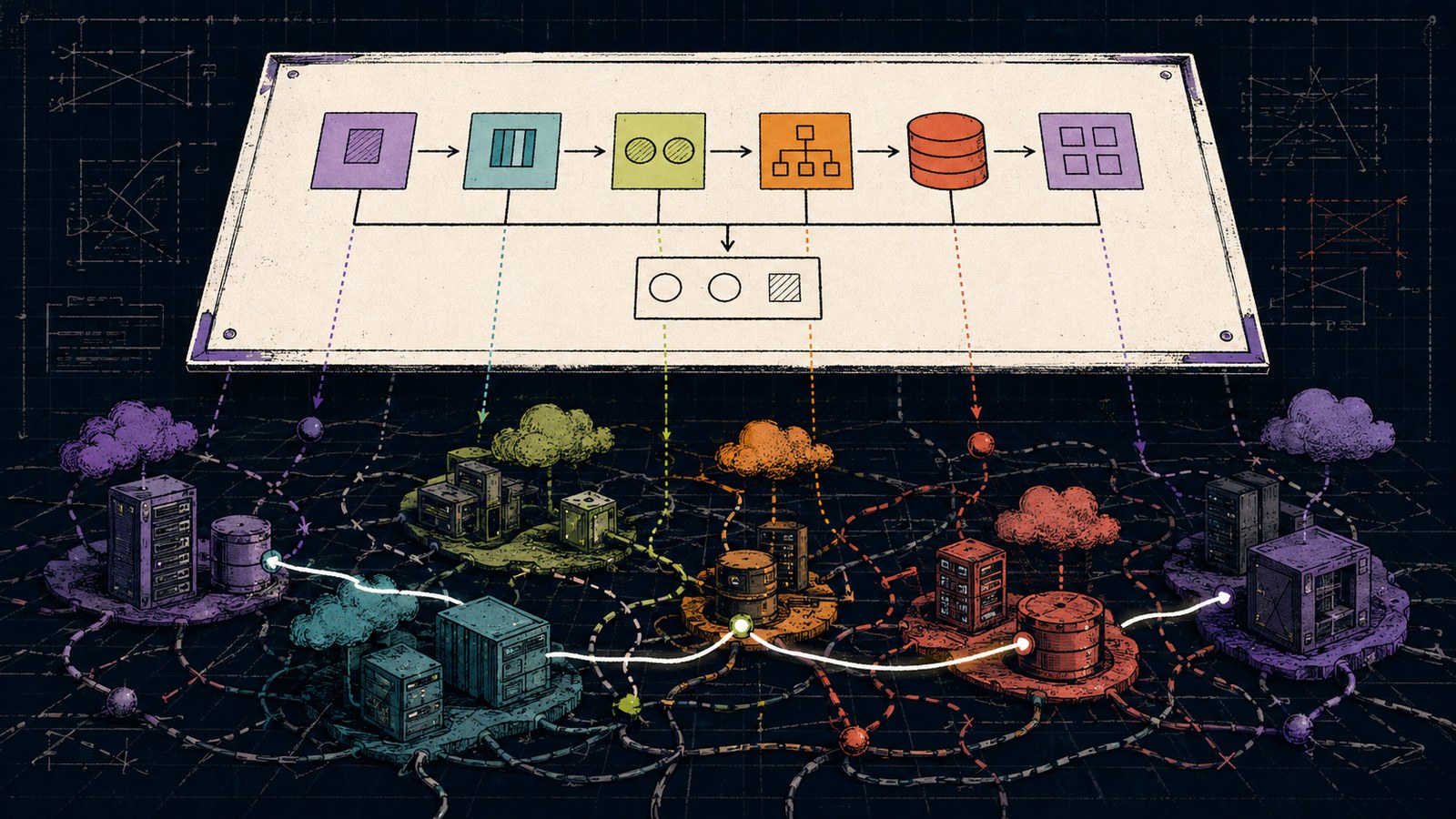
The diagram had survived a cloud migration, two acquisitions, a network redesign, and three branding updates. It remained visually excellent. Boxes aligned. Arrows avoided one another. The legend was tasteful. It appeared in onboarding decks and assessment packets because it was the only artifact that made the environment look explainable at a glance.
The team also maintained a scope spreadsheet. Unlike the diagram, it changed constantly. Rows arrived through tickets, discoveries, and annual review. Colors marked inclusion, exclusion, ownership, and uncertainty. People trusted the spreadsheet because it felt current, but the rows did not consistently link to flows, trust boundaries, or administrative paths. One artifact had shape without freshness. The other had freshness without architecture.
Narrative turn / 01
Six versions of current
When the team compared the two sources, disagreements appeared immediately. A payment support service existed in the spreadsheet but not the diagram. A retired gateway remained on the diagram but not the inventory. A newly acquired environment used the same name for a different component. Two arrows represented connections nobody could validate. Each artifact was current according to a different clock.
The search for answers became Evidence Archaeology. Network engineering had a troubleshooting sketch. The cloud team had a deployment view. An application owner had a data-flow slide. Security had firewall objects. Compliance had last year’s annotated PDF. None was the authoritative architecture, yet each contained facts the official diagram had omitted.
Narrative turn / 02
Why nobody fixed it
Updating the official picture felt risky because every change invited a bigger question. Add the acquired environment and someone would ask about its boundary. Remove the gateway and someone would ask when it retired. Draw the management path and someone would revisit the scope rationale. The diagram stayed polished because polish protected the team from reopening unresolved decisions.
Meanwhile, the spreadsheet absorbed uncertainty without resolving it. A yellow row could remain yellow indefinitely. A comment could say pending architecture confirmation for several quarters. The table became a waiting room for decisions the diagram refused to host. Together they formed a stable Cluster of Wack: one artifact simplified the story and the other postponed it.
Narrative turn / 03
The reconciliation drill
The team stopped trying to redraw everything. They selected one transaction path and one administrative path, then walked both across the diagram, spreadsheet, configurations, and owners. Each mismatch entered a log with the competing claims, available evidence, decision owner, and due date. Unknown became an explicit state instead of an embarrassing blank.
The drill produced an imperfect but dated baseline. Components carried stable identifiers. Spreadsheet rows linked to diagram nodes. Diagram edges linked to evidence or open questions. A retirement event removed the component from both views. A new trust relationship triggered review of both. The artifacts did not become identical; they became reconcilable.
What the team finally saw
Diagram Drift is not primarily a drawing problem. It is a synchronization and decision problem. Scope by Spreadsheet emerges when the table is asked to replace the relationships it can only summarize. Evidence Archaeology fills the gap when teams must excavate current facts from local artifacts and memory. The way out is not a perfect master diagram. It is a repeatable reconciliation motion with identifiers, dates, owners, triggers, and a place for uncertainty to become work.
What changed
The official diagram became less beautiful and more useful. It displayed dates, identifiers, unresolved edges, and review ownership. The spreadsheet lost several decorative status columns and gained links to architecture facts. Teams could now disagree in one visible place instead of maintaining separate versions of certainty.
At the next review, an engineer corrected an arrow without triggering panic. The mismatch entered the log, the owner validated the configuration, and both views changed together. The organization had not frozen the architecture. It had finally given change a route into the documentation.